
3 min read
How AI is Transforming Insurance Buying Expectations
 Mango Policy
:
Mar 4, 2026 10:36:25 AM
Mango Policy
:
Mar 4, 2026 10:36:25 AM
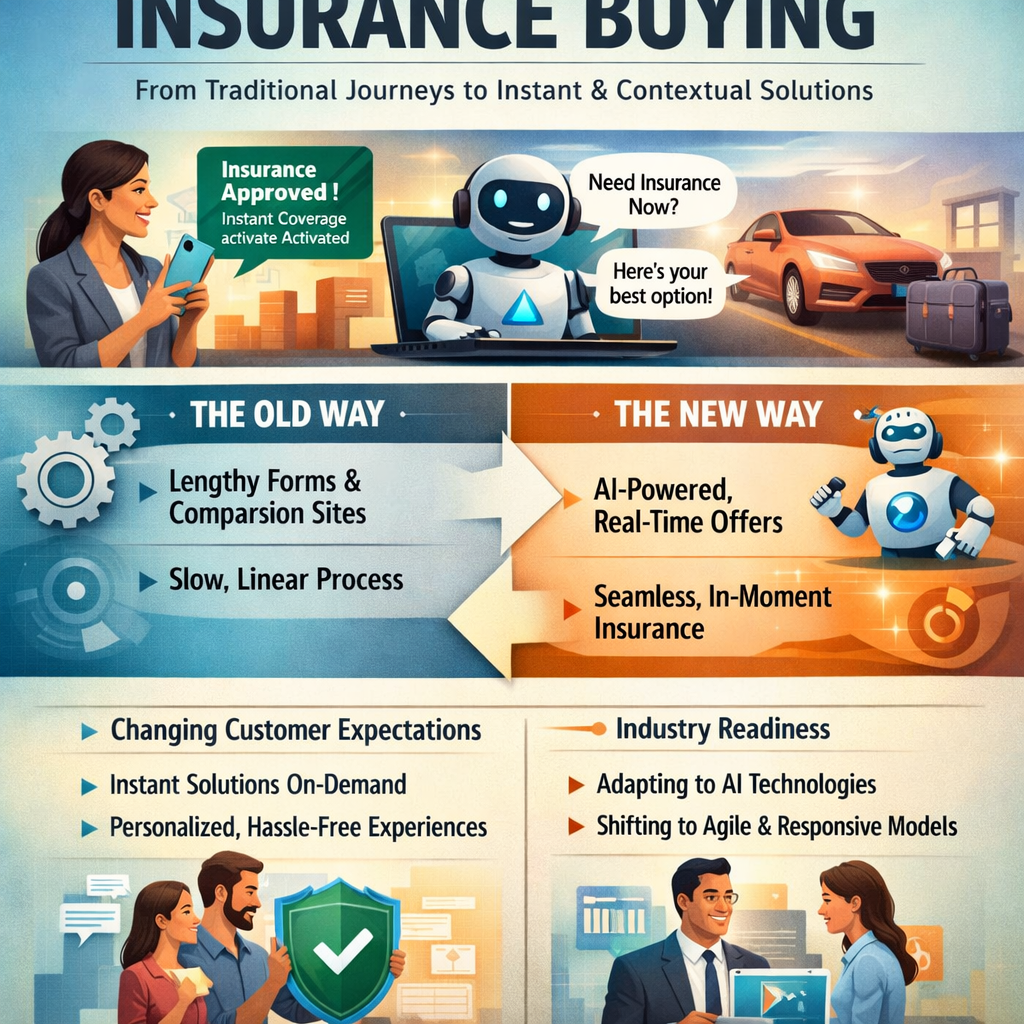
The insurance industry has spent years talking about digital distribution.
Websites were the first step. Then came embedded experiences, self-service portals, and simplified quote journeys.
Now AI assistants are entering the conversation - and while much of the discussion focuses on whether customers will buy insurance inside tools like ChatGPT, that question misses the bigger shift.
AI isn’t just creating a new distribution channel.
It’s resetting customer expectations.
From Research to Resolution
For most of the last two decades, buying insurance online followed a familiar pattern:
Search -> Compare -> Click -> Quote -> Bind
Even well-designed digital journeys still assumed the customer would navigate multiple steps, often across multiple sites. And have patience for the back & forth that comes with a sale.
AI changes that behavior.
Instead of researching options, customers can describe their situation in plain language and expect a direct answer:
“I'm moving into an apartment next month - what insurance do I need?”
“I just bought a puppy - should I get pet insurance?”
“I’m starting a small contracting job - do I need a bond?”
More importantly, once they receive a recommendation, they expect to act immediately.
The shift isn’t just toward conversation- it’s toward resolution.
If a need is identified, customers increasingly expect the solution to be completed on the spot.
The Rise of Contextual Buying
AI assistants are one place this behavior will show up, but they won’t be the only place - or even the primary one.
Insurance demand often appears at specific moments:
- Signing a lease
- Adopting a pet
- Registering a business or contractor license
- Booking travel
- Financing a purchase
- Reading about a new requirement or risk
In these moments, the winning product won’t necessarily be the one with the best marketing or brand recognition.
It will be the one that can be quoted and issued immediately, within the context where the need appears.
This is the broader shift underway: distribution is moving closer to the moment of need.
AI is accelerating the expectation, but the change applies across websites, partner platforms, embedded experiences, and event-triggered workflows.
Why Simple Products Are Most Affected
This shift matters most for low-premium, high-volume products:
- Renters
- Pet
- Event
- Travel
- Small contractor coverage
- Bonds
- Device or warranty protection
These products depend on efficient acquisition and minimal servicing. Any friction...manual underwriting, callbacks, delayed follow-up, erodes both conversion and profitability.
In a contextual environment, that friction becomes a competitive disadvantage.
If a customer is signing a lease and one option can be bound instantly while another requires a broker to follow up later, the decision is effectively made.
The competitive landscape shifts from:
Who offers this product?
to:
Who can complete the transaction right now?
Digital Readiness Becomes Distribution Readiness
For many organizations, digital transformation has focused on improving the customer interface.
But contextual distribution requires something deeper: operational readiness.
To participate in emerging environments - whether AI-driven, embedded, or event-based - products need to be:
- Fully quoteable without manual intervention
- Instantly bindable
- Accessible through APIs or embedded workflows
- Structured for automated eligibility and decisioning
Think of this as digital liquidity - the ability for a product to move easily into whatever channel or context demand appears.
Without it, even strong products may never be surfaced at the moment customers are ready to buy.
What This Means for the Industry
This shift doesn’t eliminate the role of brokers or agents. Complex risks will continue to require advice and relationship-driven distribution.
But for simple products, customer expectations are changing quickly.
If coverage can be purchased in minutes, customers will expect to do exactly that — wherever the need arises.
Organizations that prepare their products for instant fulfillment will have far more flexibility to participate in:
- Embedded partnerships
- Marketplace distribution
- AI-assisted recommendations
- Broker-branded digital experiences
- Event-triggered purchase flows
Those that rely on manual processes for low-premium business will face rising acquisition costs and declining conversion as expectations evolve.
The Real Question
The industry conversation often focuses on whether AI will become a major distribution channel.
But the more important question is broader:
When a customer realizes they need coverage - wherever that moment happens - can your product be issued immediately?
For simple insurance, the future competitive advantage may not be brand, price, or even coverage.
It may come down to a single capability:
Can the policy be issued instantly, in the moment the customer asks for it?
Organizations that can answer yes will be positioned for whatever distribution environment comes next.
Those that can’t may find that demand still exists, but the decision is being made somewhere they aren’t able to participate.