
2 min read

Navigating New AI Companion Laws - Implications for Insurance Organizations

Navigating New AI Companion Laws - Implications for Insurance Organizations

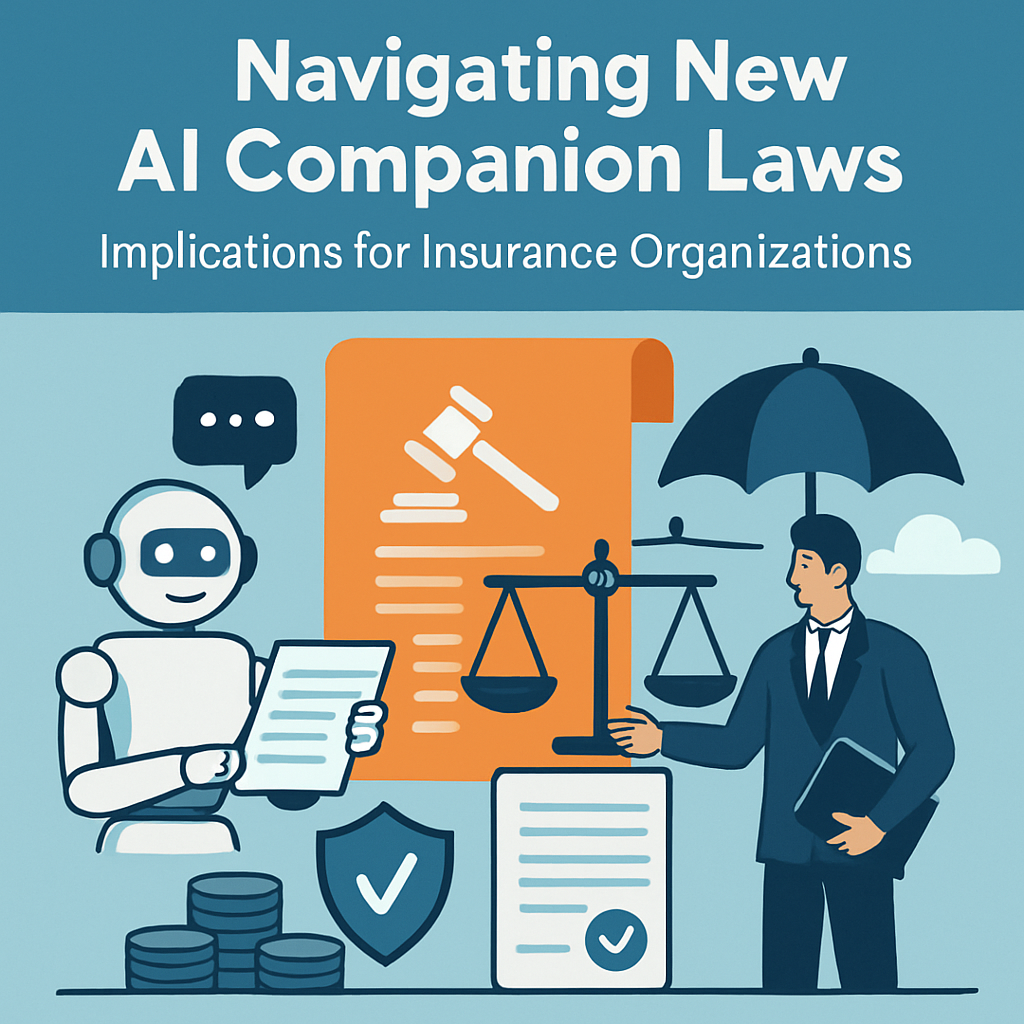
As insurance organizations eagerly adopt artificial intelligence (AI) technologies, recent regulatory developments in states like New York and California introduce significant implications, especially regarding AI companions-AI systems designed to simulate human-like relationships and emotional support. These new laws could expose insurers to both insurance-specific AI compliance risks and broader civil liabilities under emerging AI companion regulations, creating a potential double challenge of legal obligations and enforcement risks.

AI Companion Laws in New York and California: Overview

New York’s AI Companion Models law, effective November 5, 2025, and California’s SB 243, effective January 1, 2026, represent landmark regulations targeting AI companions. These are chatbots or systems that sustain ongoing, personalized, human-like interactions with users by retaining prior interaction data and asking unsolicited emotional questions. Both laws require operators to notify users clearly and frequently that they are interacting with AI rather than humans. New York mandates notifications at the start of every interaction and every three hours during prolonged sessions. California requires similar disclosures and adds further protections for minors, including preventing sexually explicit content and requiring annual reporting on crisis referrals related to suicidal ideation[1][3].

Both states also require AI companion operators to implement protocols to detect and respond to suicidal ideation and self-harm content, including referral to crisis service providers. California further demands public disclosure of these protocols on company websites and imposes stricter safeguards for known minors interacting with AI companions.

Implications for Insurance Organizations

Insurance companies are increasingly integrating AI for underwriting, claims processing, customer engagement, and risk assessment. Some insurers may deploy AI systems with companion-like features, such as chatbots offering emotional support or personalized advice, which could fall under these laws’ definitions.

  1. Dual Regulatory Exposure
    Insurance organizations face two layers of compliance risk. First, insurance-specific AI regulations govern fairness, transparency, and accountability of AI in underwriting, claims decisions, and pricing. Regulators scrutinize AI for potential biases, discriminatory outcomes, and accuracy in risk assessment. Second, if an insurer’s AI exhibits companion-like behavior, sustaining human-like relationships, emotional engagement, or personalized ongoing dialogue, it may trigger obligations under New York and California laws. This includes mandatory disclosures, safety protocols, and protections for minors.

This intersection means insurers could be subject to both insurance regulatory oversight and civil penalties under AI companion laws, increasing the complexity and cost of compliance.

  1. Increased Liability Risks
    New York allows the attorney general to seek civil penalties up to $15,000 per day per violation for AI companion law breaches. California permits individuals harmed by violations to seek actual damages, raising the stakes for noncompliance. Given the scale of insurer customer bases, even isolated violations could multiply into substantial financial exposure.

  2. Operational and Ethical Challenges
    Insurers must carefully evaluate whether their AI products qualify as AI companions. This requires auditing AI systems for features such as memory of prior interactions and unsolicited emotional questioning. They must then design robust notification systems, implement crisis response protocols, and ensure compliance with minor-specific safeguards, especially in California.

  3. Data Privacy and Intellectual Property Considerations
    California’s requirement to publish crisis protocols publicly could expose proprietary methods or sensitive data. This necessitates careful legal and strategic planning. Insurers must balance transparency with protecting trade secrets and competitive advantage.

Preparing for Compliance

Insurance organizations should take several steps to prepare:

  • Conduct comprehensive audits of AI tools to identify companion-like features.
  • Develop and implement clear user disclosures that AI is not human.
  • Establish and document protocols for detecting and responding to suicidal ideation and self-harm.
  • Implement age verification or other mechanisms to identify minors and apply appropriate safeguards.
  • Train staff and update terms of service to reflect new obligations.
  • Monitor evolving AI regulations across jurisdictions beyond New York and California, such as Utah’s AI disclosure law, to anticipate further compliance needs.

Conclusion

As AI becomes integral to insurance operations, the emergence of AI companion laws in key states adds a critical layer of regulatory complexity. Insurance organizations could indeed face a double challenge: being held accountable under both insurance-specific AI regulations and broader civil AI companion laws. Proactive compliance strategies are essential to mitigate legal risks, protect vulnerable users, and maintain trust in AI-driven insurance services.

For a detailed analysis, see the original article by Knobbe Martens on preparing for AI companion regulations:
https://www.knobbe.com/updates/how-businesses-can-prepare-for-regulations-on-artificial-intelligence-companions/


ODN Expands Business Development Team

3 min read

ODN Expands Business Development Team

ODN Expands Business Development Team by Carly Burnham In January 2020, ODN welcomed Lanaya Nelson to the executive management team to lead...

Read More
Profiles in Risk: E451 – Managing Extreme Climate Risk With Better (Business) Models; Andrew Engler, CEO, Co-Founder of Kettle

2 min read

Profiles in Risk: E451 – Managing Extreme Climate Risk With Better (Business) Models; Andrew Engler, CEO, Co-Founder of Kettle

Profiles in Risk: E451 – Managing Extreme Climate Risk With Better (Business) Models; Andrew Engler, CEO, Co-Founder of Kettle by Nicholas...

Read More
Why the East Coast Needs a Dedicated InsurTech Accelerator?

3 min read

Why the East Coast Needs a Dedicated InsurTech Accelerator?

Why the East Coast Needs a Dedicated InsurTech Accelerator? by David Gritz Background on East Coast InsurTechs With over 500 InsurTech startups...

Read More