
2 min read
“Act2” – A Creative Solution to our Talent Crisis
“Act2” – A Creative Solution to our Talent Crisis by Antonio Canas We spend a lot of time talking about the upcoming demographic and talent...
5 min read
Audry Torrence
:
Jan 28, 2026 8:58:21 AM
This guest article first appeared in The Insurance Lead HERE
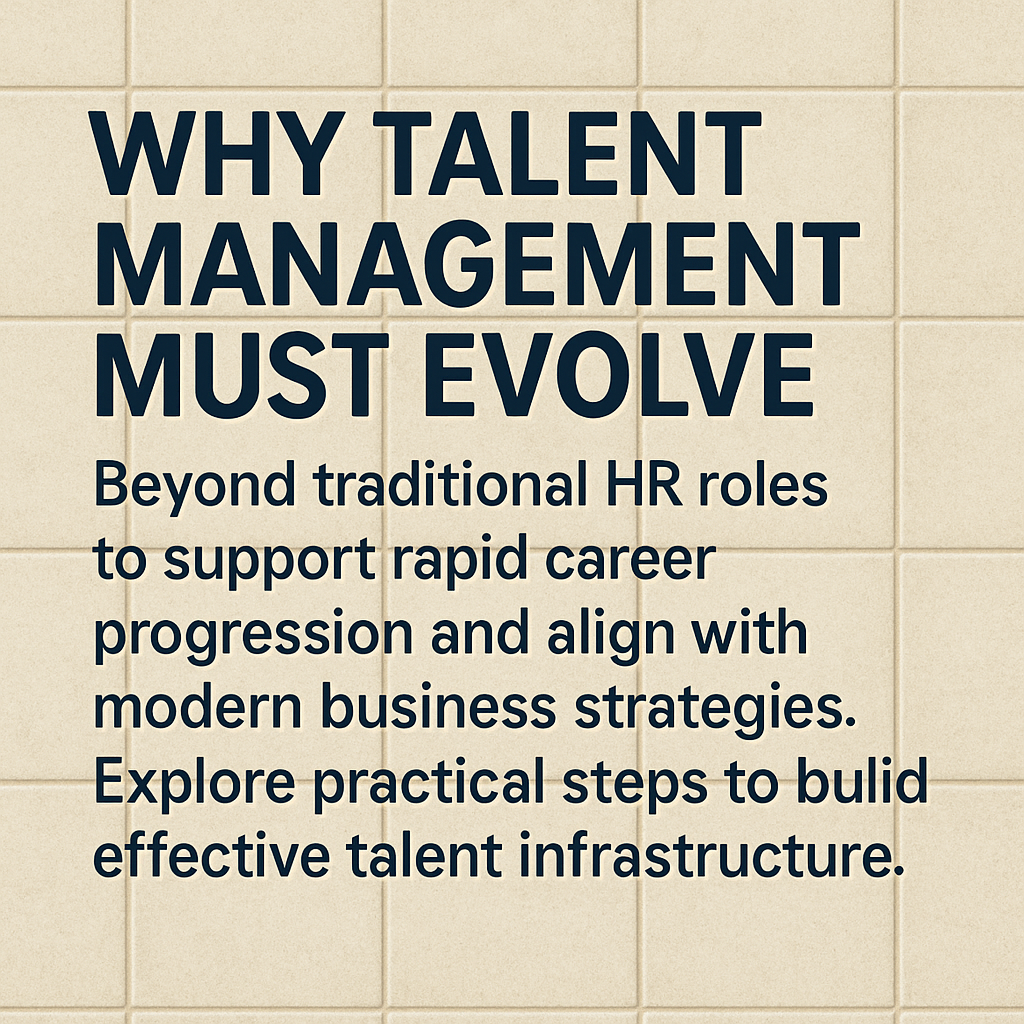
Talent Acquisition and its younger sibling, Talent Management, entered the corporate insurance scene about 25 years ago as a distinct function. Digitalization is now compressing career timelines and transforming today’s early career learning and experience. As HR fulfills its expanding operational and compliance responsibilities, organizations require a new and separate next-gen talent infrastructure that can guide development, mobility, and capability planning in alignment with enterprise strategy.
In my work across the P&C insurance ecosystem, I have watched underwriting, claims, distribution, and operations careers accelerate faster than the organizational systems built to support them. Digitalization has removed much of the hands-on foundational work that once taught judgment and pattern recognition. As a result of this shift and several other industry forces, people are stepping into higher-level roles much earlier. It is now common for me to meet professionals who reach a VP title within three years.
There is nothing inherently wrong with that acceleration. But it does require organizations to build talent infrastructure that can support development, mobility, and capability-matching at the speed the industry now operates. Most companies are still using models built for a very different era, and those models are no longer sufficient for how quickly people advance today.
The opportunity is clear. The only thing missing is the infrastructure powerful enough to unlock it.
Insurance careers were historically built through a slow layering of experience. Underwriters learned by reading files, researching similar accounts, tracing rate history, and manually comparing exposures. Claims professionals learned by reviewing documentation, analyzing patterns, interviewing people, and following a case through its lifecycle. Operations and distribution roles built instinct and judgment through repetition, observation, and context.
That learning cycle no longer exists in the same way. Automation, integrations, and straight-through processing have removed the repetitive tasks that once gave early-career employees the opportunity to study patterns and internalize judgment. People can follow workflows and execute tasks accurately, but they have not had the slow accumulation of experience that once developed intuition.
This is not a generational issue. It is a structural one. The business has changed faster than the learning model that supports it. If organizations want employees to make sound judgments earlier in their careers, they must create modern systems that intentionally build that capability rather than rely on the apprenticeship model that no longer exists.
When companies look for where talent development, capability design, internal mobility, workforce forecasting, and strategic hiring should live, the default answer is often HR. But the role of HR today is fundamentally different from what it was when most of our talent assumptions were created.
HR now carries a multi-jurisdictional compliance mandate. It manages wage and hour requirements, benefits complexity, labor regulations, employee relations, leave administration, accessibility standards, and the risks associated with remote and hybrid environments. HR is now an operational risk and regulatory function. It is essential work, and it is increasingly complex.
Because of that scope, HR does not have the bandwidth or structural positioning to also serve as the enterprise-wide steward of capability building, mobility architecture, or long-term talent forecasting. Traditional talent acquisition is also limited in scope. Its remit is hiring, not solving enterprise capability problems or designing the architecture for how talent moves and develops.
This is not an HR shortcoming. It is a structural mismatch between the scale of today’s talent mandate and the systems designed to support it. The issue is not HR. The issue is architecture. Effective talent management requires organizational infrastructure at the same level of intention and reach as technology.
Technology offers a straightforward analogy. Thirty years ago, IT was a support function. When something broke, you called them. In its early years of insurance industry adoption, technology was viewed as an alternate or an add-on; then it became necessary; now it is strategic.
As technology became embedded across underwriting, claims, finance, operations, and distribution, “the IT department” shifted from support to infrastructure. A function becomes infrastructure when it becomes inseparable from business performance.
Talent is undergoing the same transformation now. Most organizations have not yet updated their systems – or their thinking – to reflect that shift.
Companies forecast technology needs. They evaluate tools, design integrations, and monitor performance. They do not leave technology decisions to chance.
Yet talent, which determines whether strategy succeeds, is still managed as a collection of transactions rather than an integrated system.
This is where the gap becomes visible. Who maps capabilities across the enterprise? Who aligns skills with emerging lines before hiring becomes urgent? Who prepares employees for redeployment before a business contraction becomes a staff reduction? These responsibilities sit both everywhere and nowhere. The work is essential, but it is structurally homeless because the architecture has not yet been built.
These forces compress the talent cycle and expose the limits of systems built for a slower, more linear career progression.
Treating talent as infrastructure means creating the systems that support how people develop, advance, and contribute. In practice, that looks like:
Roles are defined based on business requirements rather than generic job descriptions.
Workforce planning becomes proactive and tied to strategic goals.
High potential individuals are identified early and developed intentionally.
Internal mobility becomes structured and visible.
Training aligns to real capability needs.
Recruiting becomes an extension of business planning rather than an isolated transaction.
Capability gaps are identified and addressed before they impact execution.
The industry cannot return to the slower, multi-year development pathways of the past. Technology has changed the work itself. HR must continue to focus on operational risk and compliance. Employees will continue advancing quickly.
The question is whether companies will build the talent infrastructure required to support this new environment.
If they do not, early leaders will lack direction, mid-career professionals will disengage, and strategy will outpace capability and execution.
If they do, talent becomes an operating system. The organization becomes more resilient, more aligned, and better prepared for the future. Employees receive guidance that matches the complexity of their roles. Leaders gain clarity. Strategy becomes executable.
Technology became a competitive advantage only after it became infrastructure. Talent will follow that same path. The organizations that build this infrastructure now will define the next era of insurance performance.
2 min read
“Act2” – A Creative Solution to our Talent Crisis by Antonio Canas We spend a lot of time talking about the upcoming demographic and talent...
1 min read
How To Retain & Attract Knowledge and Talent In The Insurance Industry (Webinar Rewind) by Nicholas Lamparelli On Leap Day, 2/29,2024, Insurance
1 min read
Hey #Insurance – Ep 110 – Talent Hoarding by Antonio Canas About Antonio Canas Tony started in insurance in 2009 and immediately...