2 min read

New Talent Models for MGA Success: Navigating Growth Challenges

New Talent Models for MGA Success: Navigating Growth Challenges

The rapid growth of Managing General Agents (MGAs) is currently facing a significant, yet frequently ignored, hurdle: a deficit of seasoned professionals to maintain this trajectory. While financial resources and technological capabilities are advancing rapidly, the essential human capital required for strategic direction, operational rigor, and underwriting integrity is falling short. Addressing this disparity necessitates a revised talent framework. This new model should feature a streamlined central leadership, supported by empowered direct reports, and leverage adaptable technology and external partnerships to navigate the inherent volatility of the MGA sector.

Traditional MGA models have relied heavily on large, experienced teams embedded within the organization to manage underwriting, compliance, actuarial analysis, and distribution. However, as Joe Zuk points out in his LinkedIn article, the industry faces three main talent pinch points: 

  • The retirement of seasoned executives ("The Boomer Brain Drain"),
  • The exodus of talent from carriers to entrepreneurial MGAs, 
  • and the mismatch between capital availability and execution capability. 

These factors create a risk that many MGAs lack the operational maturity and leadership depth to sustain long-term growth.

To address this, a new talent model is emerging, centered on a lean core team that drives the MGA’s strategic vision, mission, and culture. This core team typically consists of senior leaders with deep underwriting acumen, actuarial expertise, and a strong entrepreneurial mindset. Their role is to set clear strategic priorities, maintain governance discipline, and cultivate a strong culture aligned with sustainable growth.

Directly reporting to this core team are mission-driven managers and specialists who execute the MGA’s day-to-day operations and growth initiatives. These individuals are empowered to make decisions aligned with the core strategy but focus on operational execution, underwriting rigor, compliance adherence, and distribution management. This layer serves as the bridge between the leadership vision and operational reality, ensuring the MGA remains agile yet disciplined.

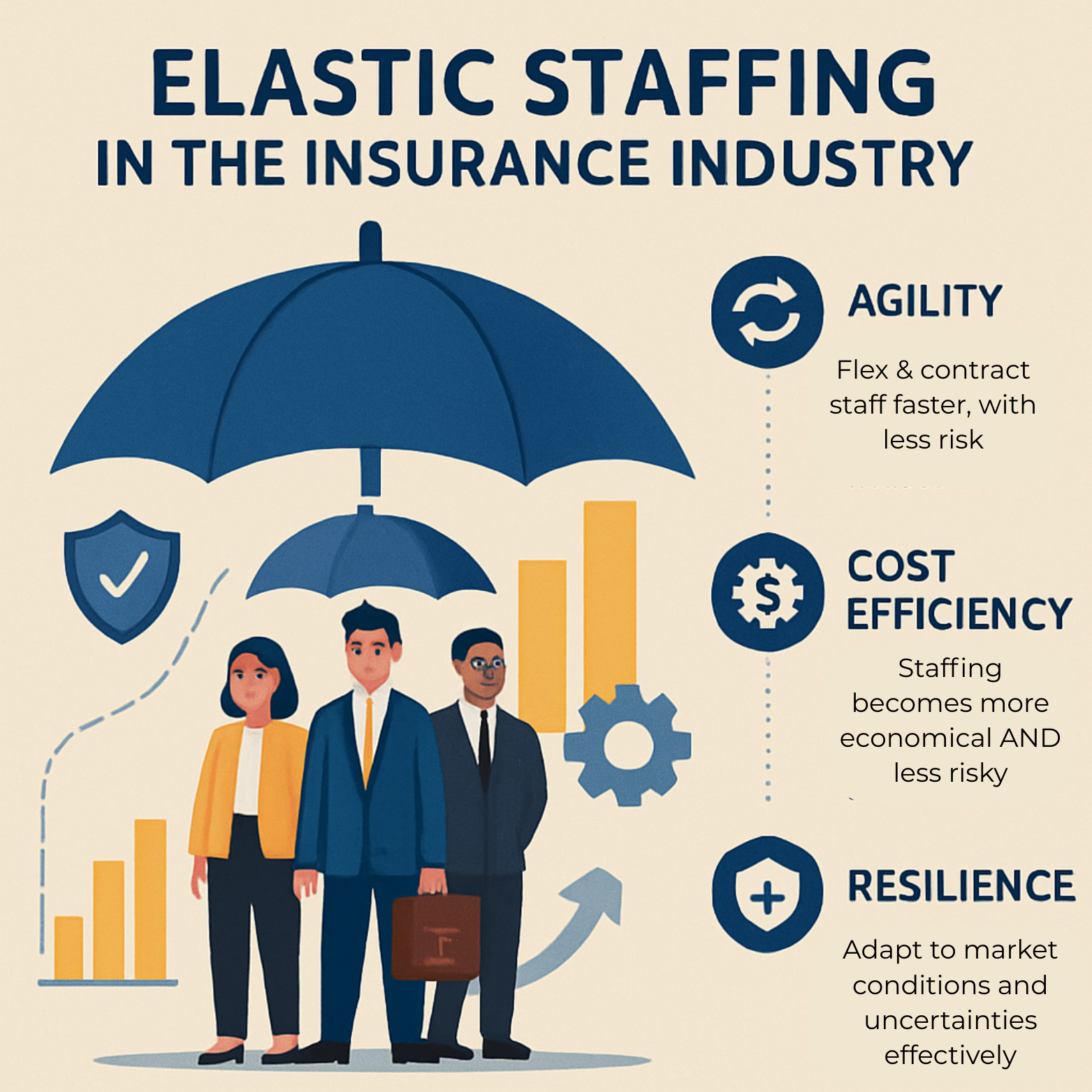
Crucially, this model leverages technology platforms and external vendor partners to elastically scale resources and capabilities in response to business volatility and growth cycles. Instead of building large, fixed internal teams, MGAs partner with specialized vendors for underwriting support, claims handling, actuarial services, compliance, and IT infrastructure. These partnerships provide access to deep expertise and scalable capacity without the overhead and rigidity of permanent staffing. For example, platforms like Accelerant and Hadron offer integrated ecosystems that align underwriting, compliance, reinsurance, and capital management, enabling MGAs to maintain underwriting integrity while scaling rapidly.

This hybrid talent model offers several advantages:

  • Agility and scalability: MGAs can quickly adjust their operational footprint up or down, matching market demand and premium flow without the lag of hiring or layoffs.
  • Cost efficiency: Outsourcing specialized functions reduces fixed costs and allows MGAs to invest capital in growth and technology rather than large headcounts.
  • Focus on core strengths: The lean leadership team concentrates on strategy, culture, and risk management, while execution partners handle specialized or transactional tasks.
  • Talent development and retention: By focusing internal resources on mentorship and leadership development, MGAs can build a pipeline of future leaders while relying on external partners for scale.

This approach also mitigates the risks highlighted by the "Capacity-to-Execution Mismatch," where too many MGAs launch with untested teams and unclear delegation authority. The lean core team ensures strong governance and operational discipline, while external partners provide proven infrastructure and expertise.

Industry data supports this shift. Nearly half of insurers cite talent recruitment and retention as the biggest barrier to growth, with specialty expertise in underwriting and claims particularly scarce.. The insurance sector is also competing with other industries for tech-savvy and data-driven professionals, making it harder to build a large internal team. Leveraging external ecosystems and technology-enabled vendors becomes a strategic imperative in this environment.

In conclusion, the future of MGA success lies not just in capital or technology but in a new talent architecture: a lean core leadership team driving strategy and culture, empowered direct reports focused on execution, and an elastic network of technology and vendor partners providing scalable support. This model balances agility, operational rigor, and sustainable growth, addressing the industry's most pressing talent constraints while positioning MGAs to thrive in a fast-evolving market.


Addressing the Talent Crisis in Insurance: A Systemic Approach

3 min read

Addressing the Talent Crisis in Insurance: A Systemic Approach

The insurance industry faces a persistent talent crisis, driven by a significant gap between available skilled professionals and industry needs,...
Read More
Responsive Scaling: A Strategic Approach to Staffing in Insurance Organizations

6 min read

Responsive Scaling: A Strategic Approach to Staffing in Insurance Organizations

Note: A webinar on this topic can be found at the end of this article Insurance organizations operate in a unique and challenging environment. As...

Read More
Profiles in Risk – E84: Matteo Carbone on His Career, Insurance Innovation and His New Baby – Archimedes SPAC

16 min read

Profiles in Risk – E84: Matteo Carbone on His Career, Insurance Innovation and His New Baby – Archimedes SPAC

Profiles in Risk – E84: Matteo Carbone on His Career, Insurance Innovation and His New Baby – Archimedes SPAC by Nicholas Lamparelli Audio...

Read More